
What are the best souvenirs to buy in Egypt?
Cartouche jewelry, papyrus scrolls & alabaster carvings top the list — buy from licensed workshops in Khan El Khalili, Luxor & Aswan for authenticity.
Cartouche jewelry custom name in hieroglyphs, $15–40 silver, made in minutes
Watch it made papyrus/alabaster workshops let you verify authenticity live
Bargain 40–50% offer half the first price; it’s expected, not rude
Aswan/Luxor cheaper lower markup than Khan El Khalili, same quality
Shopping in Egypt is not a side activity you squeeze in between temples — for most visitors it becomes part of the trip itself. The alleyways of Khan El Khalili, the alabaster workshops on Luxor’s West Bank, and the spice stalls of Aswan’s souk are living markets that have operated for centuries, and finding your way through them (bargaining included) is as memorable as standing in front of the pyramids. This guide covers the 27 best Egypt souvenirs to buy in 2026, organized by category, with realistic prices in EGP and USD, where to find each item city by city, and how to avoid the fakes that flood the more touristy stalls.
If you’re still finalizing your route, most of the souvenirs below are easiest to find while working through a 14-day Egypt itinerary, a 10-day Egypt itinerary, or a shorter 7-day Egypt itinerary that includes stops in Cairo, Luxor, and Aswan — the three cities that between them cover almost everything on this list.
Where to Shop: Markets by City
Khan El Khalili, Cairo
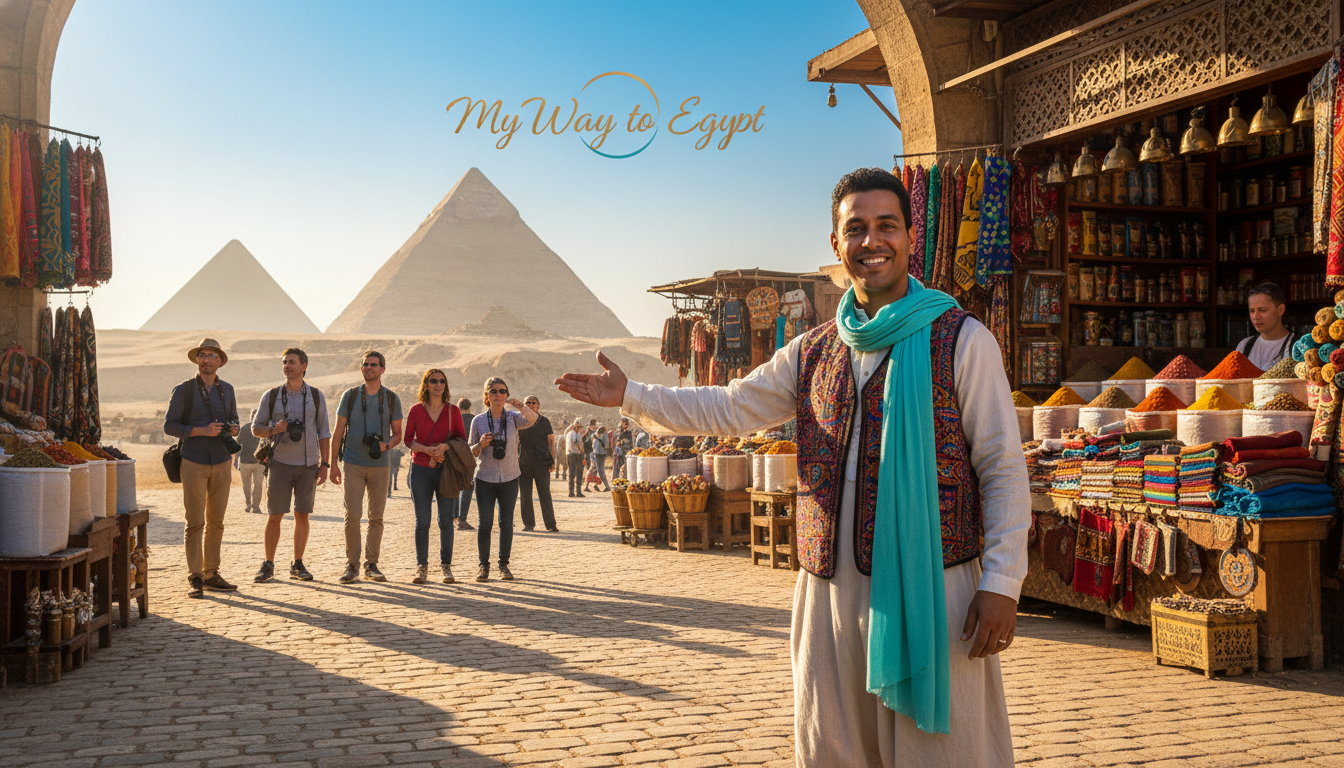
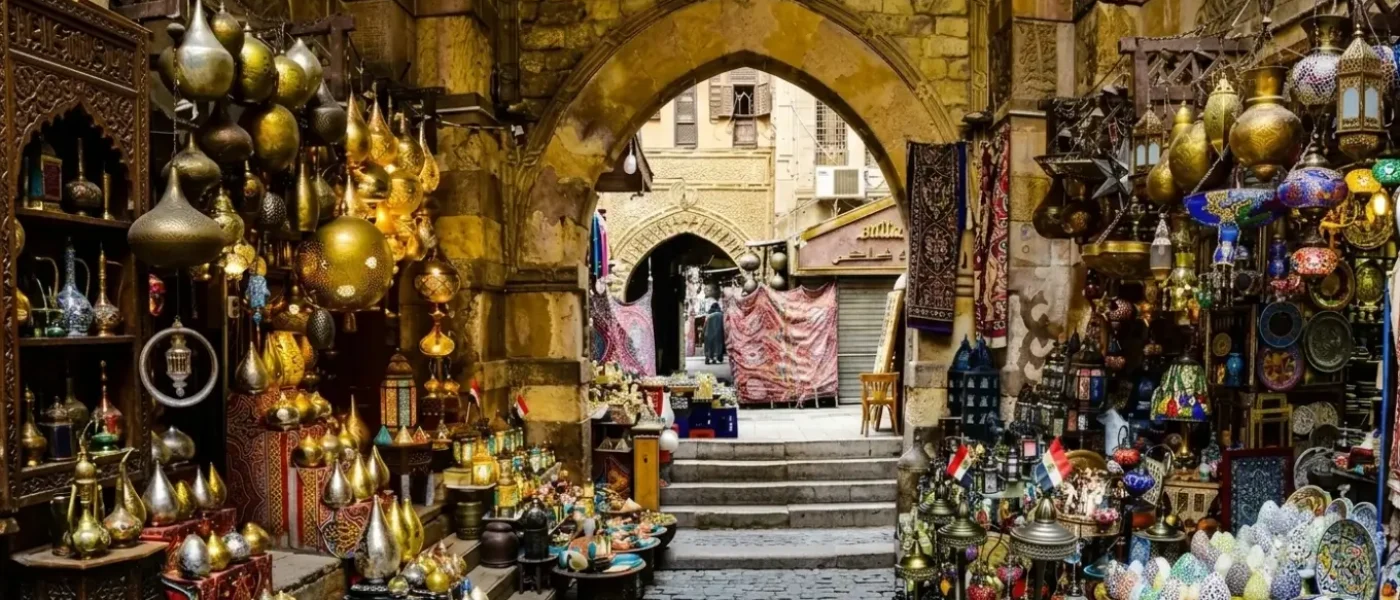
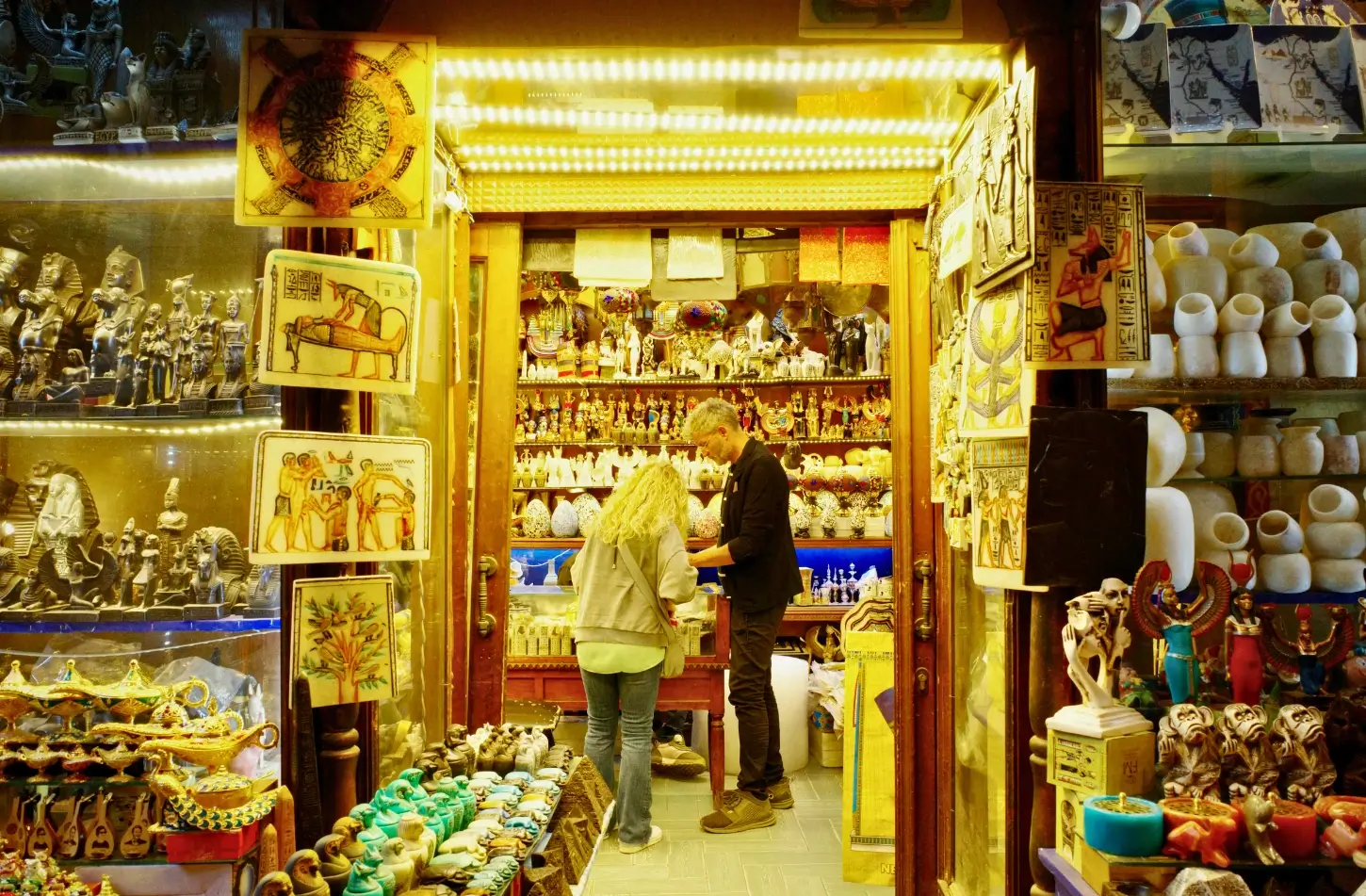
Egypt’s most famous bazaar dates back to the 14th century and remains the single best one-stop location for jewelry, papyrus, spices, textiles, and copperware. It sits within easy reach of most Cairo day tours, and pairs naturally with a broader day of exploring things to do in Cairo. Expect crowds, persistent vendors, and prices that start high — bargaining here isn’t optional, it’s expected.
Luxor Souk
Smaller and less overwhelming than Khan El Khalili, Luxor’s souk is the best place for alabaster (many workshops sit right on the West Bank near the Valley of the Kings) and is a natural stop while comparing Luxor’s East Bank and West Bank. It’s also worth building in time from your list of things to do in Luxor so shopping doesn’t get squeezed out by temple visits.
Aswan Souk
Aswan’s market has a distinctly Nubian character, with spices, baskets, and textiles in bolder colors and patterns than you’ll find further north. It’s an easy add-on to any list of things to do in Aswan, and the spice section in particular has the freshest karkadeh in the country, since it’s grown regionally.
Nile Cruise Stops
If you’re taking a Nile cruise from Luxor to Aswan, most vessels — including higher-end luxury Nile cruises — stop at Kom Ombo and Edfu, both of
which have smaller, quieter markets that are noticeably less pushy than Cairo’s, and often better for relaxed bargaining.
Market comfort also depends heavily on season — shopping through Khan El Khalili’s covered lanes in August heat is a different experience than in December. It’s worth checking the best time to visit Egypt if your itinerary has flexibility.
How to Spot Authentic vs. Fake Souvenirs
Every market in Egypt sells a mix of genuinely handmade items and mass-produced imports passed off as local craft. A few general rules apply across almost every category on this list:
- Watch it being made when possible — papyrus institutes, alabaster workshops, and coppersmiths generally let you see the process, which is the single best authenticity check.
- Weigh gold and silver in front of you — legitimate jewelers price by gram plus workmanship and will show you the scale.
- Be suspicious of “ancient” claims — genuine antiquities cannot legally be sold or exported; anything marketed as a real ancient artifact is either illegal to buy or, far more likely, not actually ancient.
- Compare prices across a few stalls before committing to the first offer — price spread alone tells you a lot about where you’re being quoted a tourist markup.
- Ask for a receipt or certificate from licensed institutes (papyrus and perfume shops especially) — it protects you if a bank or customs agent asks questions later.
Best Souvenirs by Budget
Splurge ($60+)
Large khayamiya wall hangings, detailed mother-of-pearl chess sets, sizeable hand-hammered copper trays, and gold cartouche pendants all fall in this range and make strong statement pieces or gifts for a special occasion.
Mid-Range ($15–$60)
Alabaster vases, silver cartouche jewelry, galabeyas, khayamiya cushion covers, and hand-blown perfume bottles offer the best balance of craftsmanship and price for most travelers.
Budget-Friendly (Under $15)
Papyrus bookmarks, spice blends, karkadeh tea, sand art bottles, and kohl pots are easy to buy in bulk for coworkers, classrooms, or extended family without straining a trip budget.
Best Souvenirs by Traveler Type
- History buffs: miniature pharaonic statues, painted papyrus scrolls, basalt scarab carvings.
- Jewelry lovers: cartouche pendants, lapis lazuli pieces, gold scarab rings.
- Foodies: karkadeh tea, Egyptian spice blends, Siwa olive oil, Aswan dates.
- Home decorators: copper lanterns, Nubian baskets, khayamiya wall hangings, alabaster bowls.
- Traveling with kids: sand art bottles, papyrus bookmarks, small resin statues.
The 27 Best Egypt Souvenirs, by Category
Jewelry & Precious Metals
- Cartouche Jewelry
A cartouche is an oval nameplate engraved with your name (or a loved one’s) in hieroglyphs, traditionally worn by pharaohs. It’s the single most personal souvenir in Egypt and one of the most searched-for gift ideas by visitors.
Where to buy: Silversmiths in Khan El Khalili’s Al-Muizz Street offer same-day custom engraving; jewelry co-ops in Aswan also do it while you wait.
Typical price: $15–$40 in silver, $80–$200+ in 18k gold, depending on chain length and weight.
Authenticity tip: Ask for a hallmark stamp (the Egyptian government assay mark) on gold pieces, and confirm the hieroglyph transliteration before it’s engraved — mistakes are common and hard to fix. - Gold and Silver Scarab Rings
The scarab beetle symbolized rebirth in ancient Egyptian belief, and scarab-motif rings and pendants remain a classic take-home piece.
Where to buy: Gold Souk area near Khan El Khalili, and licensed jewelers in Luxor’s souk.
Typical price: $10–$30 for silver, $60–$150+ for gold depending on karat.
Authenticity tip: Buy only from shops with a visible price list or scale — reputable dealers weigh the piece in front of you and price by gram plus workmanship. - Lapis Lazuli and Turquoise Pieces
These deep-blue and turquoise stones were prized by ancient Egyptians for jewelry and burial masks (Tutankhamun’s mask famously uses lapis inlay), and modern reproductions are widely sold as pendants and beaded bracelets.
Where to buy: Khan El Khalili’s stone and bead stalls; Aswan’s Nubian markets often have a wider color range.
Typical price: $5–$25 for small pieces; larger inlaid pendants run higher.
Authenticity tip: Genuine lapis has fine gold pyrite flecks and feels cool and slightly heavy; a uniformly bright, glassy blue with no flecks is usually dyed howlite or resin. - Khan El Khalili Handmade Silver Anklets
Traditional filigree silver anklets and bangles, often with small bells, are a favorite with travelers looking for wearable, everyday jewelry rather than display pieces.
Where to buy: Silver row inside Khan El Khalili, Cairo; smaller selection in Luxor souk.
Typical price: $8–$20 per piece.
Authenticity tip: Look for a stamped silver purity mark (usually 800 or 925); anything unmarked and very light is likely plated brass. - Alabaster Perfume Bottle Necklaces
Miniature hand-carved alabaster vessels strung as pendants combine two classic Egyptian crafts — stonework and jewelry — into one compact gift.
Where to buy: Alabaster workshops on the West Bank in Luxor, many of which let you watch the carving process.
Typical price: $5–$15.
Authenticity tip: Ask to see the piece held up to a light — true alabaster is translucent at the edges, while dyed plaster imitations stay opaque.
Papyrus Art
- Painted Papyrus Scrolls
Hand-painted reproductions of scenes from the Book of the Dead, the zodiac, or royal court life on genuine papyrus reed paper — one of the most iconic and packable Egyptian souvenirs.
Where to buy: Government-licensed papyrus institutes in Cairo (near the Giza Plateau) and Luxor’s West Bank, which also demonstrate how papyrus is made.
Typical price: $5–$15 for small unframed pieces, $30–$80 for larger detailed or framed works.
Authenticity tip: Real papyrus doesn’t crack sharply when gently rolled and shows a visible woven-reed texture from the back; banana-leaf fakes crease and tear easily. - Custom Name-in-Hieroglyphs Papyrus
Many papyrus workshops will translate and paint your name in hieroglyphic script on the spot, making it a quick personalized gift.
Where to buy: Licensed papyrus institutes in Cairo, Luxor, and Aswan (ask specifically for a demonstration workshop, not a street stall).
Typical price: $8–$20 depending on size.
Authenticity tip: Confirm the shop is a licensed papyrus institute — these carry a certificate of authenticity, which unlicensed street vendors rarely provide. - Papyrus Bookmarks
Small painted papyrus strips with hieroglyphic borders make an inexpensive, ultra-packable gift for coworkers or classroom souvenirs.
Where to buy: Museum gift shops in Cairo and Luxor souk stalls.
Typical price: $1–$4 each, often sold in sets.
Authenticity tip: At this price point authenticity matters less for gifting purposes, but the same crease test applies if you want genuine papyrus.
Stonework & Statues
- Alabaster Vases and Bowls
Hand-carved from Egyptian alabaster (calcite), these vases and bowls are produced in workshops that have operated near Luxor for generations.
Where to buy: West Bank alabaster factories in Luxor, where you can watch carvers work by hand.
Typical price: $10–$40 for small pieces, $60–$150+ for larger vases.
Authenticity tip: Genuine alabaster has natural, irregular veining and feels cool to the touch; painted plaster copies have uniform color and feel lighter than expected. - Miniature Pharaonic Statues
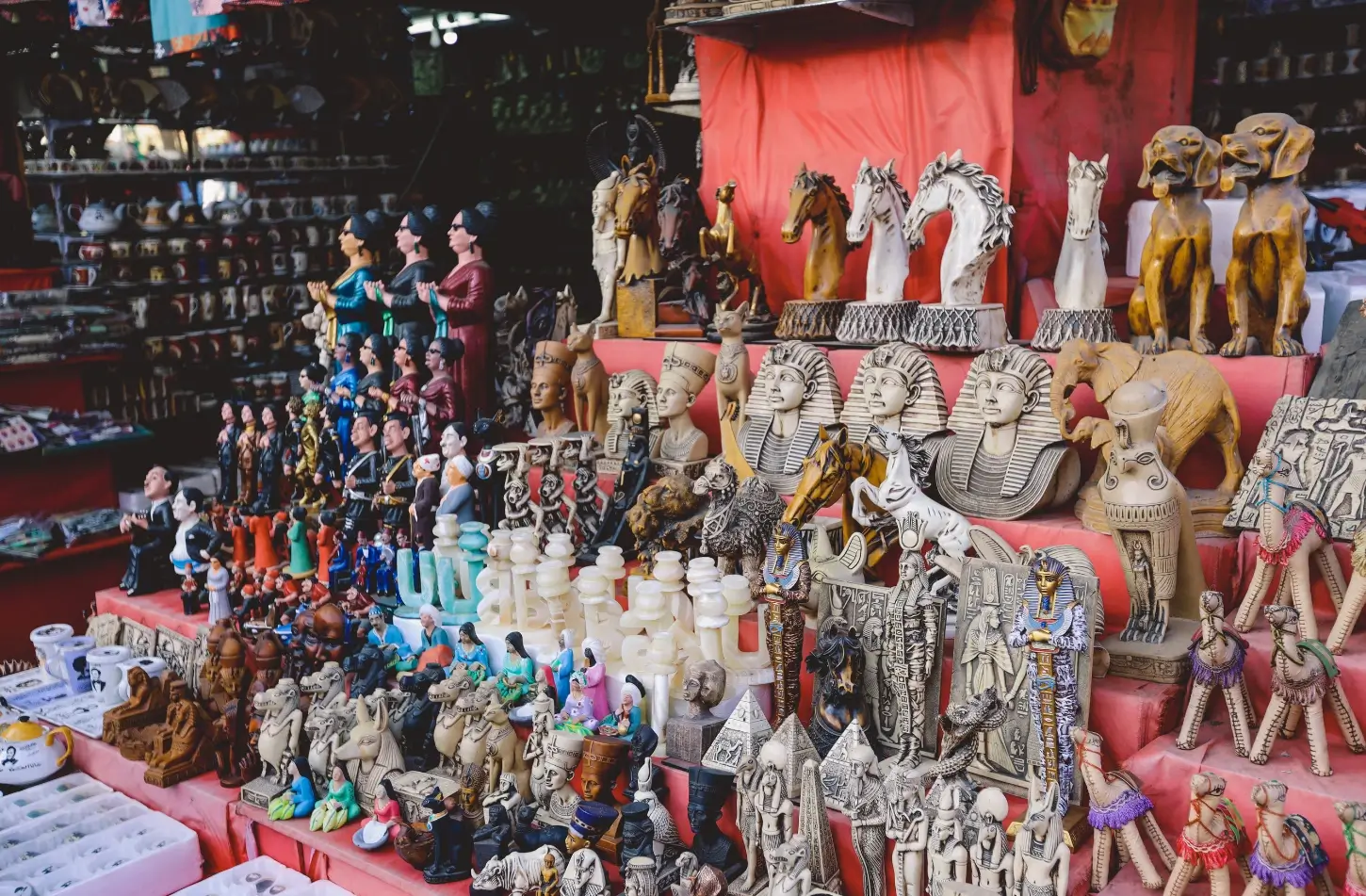
Small resin or stone reproductions of Tutankhamun, Nefertiti, Anubis, and other iconic figures are sold everywhere from museum shops to street stalls.
Where to buy: Cairo Museum gift shop for higher-quality pieces; Khan El Khalili and Luxor souk for budget versions.
Typical price: $3–$10 for resin, $20–$60 for hand-carved stone.
Authenticity tip: Resin statues are perfectly fine as decorative souvenirs — just don’t pay stone prices for a piece that’s clearly cast resin (check the seam line on the base). - Basalt and Granite Small Carvings
Denser stone carvings, often scarabs or small obelisks, in black basalt or pink Aswan granite — heavier and more premium-feeling than resin pieces.
Where to buy: Specialty stone shops in Aswan, close to the ancient granite quarries.
Typical price: $15–$50 depending on size and stone type.
Authenticity tip: Ask which quarry the stone is from — Aswan granite carvers are usually happy to explain the material, and vague answers are a red flag.
Textiles & Clothing
- Egyptian Cotton Scarves and Pashminas
Egypt is one of the world’s top producers of long-staple cotton, and hand-loomed scarves are a practical, lightweight souvenir that doubles as a travel accessory (useful for covering shoulders at religious sites, too).
Where to buy: Textile stalls throughout Khan El Khalili; cotton cooperatives in smaller Nile Delta towns sell wholesale-adjacent prices.
Typical price: $5–$15 for cotton, $15–$30 for cotton-silk blends.
Authenticity tip: Rub the fabric between your fingers — genuine high-thread-count Egyptian cotton feels smooth and slightly cool, while polyester blends feel slick or static-prone. - Galabeya (Traditional Robes)
The loose, ankle-length galabeya is everyday wear for many Egyptians and a popular costume-style souvenir, sold in everything from plain cotton to heavily embroidered festival versions.
Where to buy: Khan El Khalili’s clothing lanes and Luxor souk; tailors can often adjust the hem while you wait.
Typical price: $10–$25 for simple cotton versions, $40–$80 for embroidered or sequined styles.
Authenticity tip: Try it on before buying — sizing runs differently from Western clothing, and a good vendor will let you check the fit without pressure to buy. - Khayamiya (Appliqué Tent Fabric)
Brightly colored hand-stitched appliqué textiles, traditionally used to decorate ceremonial tents, are sold as wall hangings, cushion covers, and quilts featuring geometric or pharaonic motifs.
Where to buy: The Street of the Tentmakers (Sharia Khayamiya) in Islamic Cairo, one of the last surviving tentmaker markets in the world.
Typical price: $15–$40 for cushion-size pieces, $80–$300+ for large wall hangings.
Authenticity tip: Hand-stitched khayamiya shows slightly irregular stitching on the reverse side; machine-made imitations have perfectly uniform stitches. - Nubian Woven Textiles
Aswan’s Nubian communities produce distinctive woven baskets, rugs, and fabric with bold geometric patterns and color palettes different from Cairo’s textile style.
Where to buy: Nubian villages and markets around Aswan, often visited as part of a felucca or Nile cruise stop.
Typical price: $8–$30 depending on size.
Authenticity tip: Buying directly in a Nubian village rather than a Cairo souvenir shop usually means the money goes straight to the weaving families. - Embroidered Linen Table Runners
Hand-embroidered linen with pharaonic or floral motifs, popular as a practical home-decor souvenir that doesn’t take up much luggage space.
Where to buy: Textile stalls in Khan El Khalili and Aswan souk.
Typical price: $10–$25 depending on length and embroidery density.
Authenticity tip: Machine embroidery looks identical on both sides; hand embroidery shows slightly looser, uneven stitching on the back — a useful way to judge what you’re paying for.
Spices, Tea & Food
- Karkadeh (Hibiscus Tea)
Egypt’s national iced (or hot) tea, made from dried hibiscus flowers, is tart, deep red, and sold loose by weight in every spice market — a favorite edible souvenir because it’s cheap, light, and genuinely useful back home.
Where to buy: Aswan’s spice souk has the freshest, highest-volume turnover since karkadeh is grown in Upper Egypt; Khan El Khalili spice stalls also sell it.
Typical price: $2–$5 per 250g bag.
Authenticity tip: Good karkadeh should smell tart and slightly fruity with no musty odor — buy from a stall with visible turnover rather than a display bag that’s been sitting for months. - Egyptian Spice Blends
Dukkah (a nut-and-spice blend), baharat, and cumin-heavy mixes used in Egyptian cooking make for an easy, lightweight gift that most travelers can fit in a carry-on.
Where to buy: Spice stalls throughout Khan El Khalili, Aswan souk, and Luxor market.
Typical price: $2–$6 per bag depending on quantity.
Authenticity tip: Buy from vendors who let you smell the spice before purchase, and avoid pre-packaged tourist tins that are marked up 3–4x over loose spice by weight. - Egyptian Saffron (with a Caution)
Sold cheaply as “Egyptian saffron” in many tourist markets, but genuine saffron is not commercially grown in Egypt at scale — most of what’s sold under this name is safflower, a much cheaper substitute with a different flavor and no real medicinal value.
Where to buy: If buying safflower knowingly as a cheap tea substitute, any spice stall carries it.
Typical price: $1–$3 per bag (safflower); true saffron, if found, would cost far more per gram.
Authenticity tip: Treat any “cheap Egyptian saffron” claim with skepticism — real saffron threads are thin, trumpet-shaped, and expensive worldwide; bright orange, uniform threads sold cheaply are safflower. - Egyptian Olive Oil and Dates
Siwa Oasis olive oil and Aswan-region dates (particularly the prized Siwi and Zaghloul varieties) are high-quality, food-safe souvenirs that reflect Egypt’s agricultural regions.
Where to buy: Specialty food shops in Cairo and Aswan’s local produce markets.
Typical price: $5–$12 for olive oil, $3–$8 for a box of dates.
Authenticity tip: Check the harvest or packaging date on dates, and prefer oil bottled in dark glass, which protects quality better than clear plastic.
Perfume & Cosmetics
- Egyptian Perfume Oils
Concentrated, alcohol-free fragrance oils sold in hand-blown glass bottles — Egypt has produced perfume since antiquity, and modern perfumeries in Cairo continue the tradition with both traditional and modern scent blends.
Where to buy: Perfume shops in Khan El Khalili and dedicated perfumeries elsewhere in Cairo, many of which offer a free scent-matching consultation.
Typical price: $5–$15 for a small bottle, more for rare blends like pure lotus or amber.
Authenticity tip: Ask for a scent test on skin, not just on paper — genuine oil-based perfume develops differently on skin over an hour, while diluted or synthetic versions smell the same throughout. - Hand-Blown Perfume Bottles
The decorative glass bottles themselves — often with gold detailing and pharaonic motifs — are collected as souvenirs independent of the perfume they hold.
Where to buy: Perfume shops throughout Khan El Khalili; some glass workshops sell empty bottles only.
Typical price: $3–$10 for small bottles, $15–$30 for larger decorative pieces.
Authenticity tip: Check the glass for air bubbles and slight asymmetry, which indicate hand-blowing rather than machine-molded glass. - Black Kohl Eyeliner
Traditional kohl, used in Egypt since pharaonic times, is sold in small decorative pots with an applicator — a compact, culturally rooted beauty souvenir.
Where to buy: Cosmetic and perfume stalls in Khan El Khalili and Aswan souk.
Typical price: $2–$6 per pot.
Authenticity tip: Buy from established cosmetic stalls rather than unmarked street vendors, since kohl quality and lead content vary; reputable shops can tell you whether theirs is a modern cosmetic-safe formulation.
Home Décor & Crafts
- Copper and Brass Ware
Hand-hammered copper trays, brass lanterns, and coffee pots (often called “Egyptian lanterns” or fanous) are heavier souvenirs but make striking home décor pieces.
Where to buy: Coppersmiths’ Alley (Sharia El-Nahassin) in Islamic Cairo, part of Khan El Khalili.
Typical price: $15–$40 for small trays or lanterns, $60–$150+ for larger hammered pieces.
Authenticity tip: Genuine hammered copper shows slightly irregular dimpling from hand tooling; a perfectly smooth surface usually means machine-pressed metal sold at hand-craft prices. - Sand Art Bottles
Layered colored sand arranged into pyramid or camel scenes inside a glass bottle — an inexpensive, visually distinctive souvenir popular with younger travelers and as classroom gifts.
Where to buy: Street stalls throughout Khan El Khalili, Luxor, and Aswan; often made to order in a few minutes.
Typical price: $3–$8 depending on bottle size.
Authenticity tip: These are decorative craft items rather than “ancient art,” so the main authenticity question is just craftsmanship — watch it being made if you can, since quality varies stall to stall. - Mother-of-Pearl Inlaid Boxes
Wooden boxes and chess sets inlaid with mother-of-pearl and bone in geometric Islamic patterns, a craft tradition centered in Cairo’s old quarters.
Where to buy: Khan El Khalili’s woodworking stalls, particularly around the Al-Ghouri complex.
Typical price: $10–$30 for small boxes, $50–$150+ for detailed chess sets or large boxes.
Authenticity tip: Run a finger over the inlay — genuine mother-of-pearl has a cool, smooth, faintly iridescent surface, while plastic imitations feel warmer and look uniformly glossy. - Handwoven Baskets (Nubian and Siwan)
Palm-leaf and reed baskets in bold patterns, made in Nubian villages near Aswan and Siwa Oasis in the Western Desert, useful as both décor and practical storage back home.
Where to buy: Nubian markets around Aswan and, less commonly, specialty shops in Cairo carrying Siwan crafts.
Typical price: $6–$20 depending on size and pattern complexity.
Authenticity tip: Tightly, evenly woven palm fiber with no loose ends indicates skilled handwork; loosely woven baskets sold cheaply may not hold shape for long.
Bargaining Etiquette
Haggling is the default mode of transaction in Egyptian markets, not an awkward exception, and most vendors expect and enjoy the exchange rather than finding it rude.
- Start low: offering 40–50% of the first quoted price is normal, not insulting.
- Stay friendly: bargaining is social — a smile and some light conversation go further than a hard stare.
- Know your ceiling before you start: decide the maximum you’ll pay and don’t move past it just because a vendor pushes back.
- It’s fine to walk away: a genuine walk-away often produces the vendor’s best offer — and if it doesn’t, there’s usually a nearly identical stall a few meters on.
- Cash helps: many stalls offer a small discount for cash over card, which also factors into your overall daily travel budget in Egypt.
Bargaining is also easier when you’re not worried about basic safety — most tourist markets are well patrolled, but it’s worth reading a general overview of whether Egypt is safe to travel before your trip so you can focus on enjoying the back-and-forth instead of feeling on edge.
What Not to Buy: Customs & Legal Notes
Egypt has strict antiquities laws: it is illegal to buy, sell, or export any genuine ancient Egyptian artifact, and doing so — even unknowingly — can result in serious legal trouble at customs on the way out. Everything sold openly in tourist markets and licensed workshops is a modern reproduction, and reputable vendors will confirm this without hesitation.
- Never buy from anyone claiming to sell “real” ancient artifacts, coins, or mummified remains — these claims are either false or illegal, and sometimes both.
- Ivory and genuine coral products are restricted or banned for export in many destination countries — avoid them regardless of what a vendor claims.
- Keep receipts for higher-value jewelry or alabaster purchases in case you’re asked about them at the airport.
These rules are worth reviewing alongside broader first-time Egypt travel tips, since customs questions come up more often than most first-time visitors expect.
Shipping Large Souvenirs Home
Bulkier purchases — large alabaster vases, sizeable khayamiya hangings, or a full mother-of-pearl chess set — don’t always fit in a suitcase. Many established workshops in Khan El Khalili and Luxor offer international shipping for an additional fee, usually calculated by weight and destination.
- Get a written shipping quote and estimated delivery window before paying in full.
- Ask whether the price includes insurance — fragile stonework and glass perfume bottles are the most common breakage claims.
- Photograph the item before it’s packed, in case you need to file a damage claim later.
Packing Tips for Fragile Souvenirs
- Wrap alabaster and glass items in clothing rather than paper — soft fabric absorbs shock better and doubles as packing material you’re already carrying.
- Pack fragile pieces in the center of your suitcase, surrounded by shoes or rolled clothing, not against the outer shell.
- Carry papyrus flat rather than rolled if you have room — rolling for years can create creases that don’t fully flatten out again.
- Keep perfume oils and kohl in a sealed bag inside checked luggage in case of leaks.
Frequently Asked Questions
What is the most popular souvenir to buy in Egypt?
Cartouche jewelry is consistently the most popular souvenir, since it can be personalized with a name in hieroglyphs and made to order within minutes at most jewelry stalls.
Is it rude to bargain in Egyptian markets?
No — bargaining is the standard and expected way of buying in Egyptian souks, and most vendors price their first offer well above what they actually expect to receive.
Can I bring papyrus and alabaster through customs?
Yes, modern reproductions bought from licensed shops are legal to export; only genuine ancient artifacts are restricted, and licensed papyrus institutes and alabaster workshops sell reproductions, not antiques.
Where is the cheapest place to buy souvenirs in Egypt?
Aswan and Luxor souks tend to have lower starting prices than Khan El Khalili in Cairo, simply because they see less tourist foot traffic and less aggressive markup as a result.
Is Egyptian gold jewelry a good buy?
It can be, since Egypt has a long jewelry-making tradition and competitive gold pricing, but always confirm the karat, get the piece weighed in front of you, and buy from a shop with a visible hallmark stamp.
How much cash should I carry for souvenir shopping?
Carrying a mix of small EGP notes for spice, textile, and craft stalls, plus a card as backup for larger jewelry or alabaster purchases, covers most situations without needing to break large bills mid-negotiation.
What souvenirs should I avoid buying in Egypt?
Avoid anything marketed as a genuine ancient artifact, ivory or coral products, and “Egyptian saffron” sold suspiciously cheap — it’s almost always safflower rather than real saffron.
Plan Your Egypt Shopping Around the Right Itinerary
The best souvenir shopping happens when it’s built into your route rather than squeezed in as an afterthought — a morning in Khan El Khalili before a Cairo tour, an hour in Luxor’s alabaster workshops after the Valley of the Kings, or a relaxed stop in Aswan’s spice souk between Nile cruise excursions. If you’d like help matching a shopping-friendly schedule to your travel dates, build a custom Egypt tour and we’ll work the right markets into your itinerary.