
How do you visit Philae Temple in Aswan?
Take a taxi to Shellal Marina, then a short motorboat to Agilkia Island — arrive by 7–7:30AM for empty grounds & best light.
Boat only no land access, 10-min ride from Shellal Marina/Philae dock
Go early 7–7:30AM beats tour groups & Upper Egypt heat
Allow 1.5–2.5 hrs enough for full complex + Trajan’s Kiosk
Sound & Light Show evening event worth it if staying overnight in Aswan
Philae Temple is the highlight of any Aswan tour — and for good reason. Accessible only by boat, rising from the shimmering waters of the Nile on Agilkia Island just south of the city, it delivers something rare: genuine solitude inside a monument of extraordinary beauty. Dedicated to the goddess Isis — deity of magic, motherhood, and healing — this sacred island temple was the last bastion of ancient Egyptian religion, where priests performed rituals well into the 6th century AD, long after the rest of Egypt had turned Christian. Whether you are exploring Aswan independently or as part of one of our Egypt tour packages, Philae Temple belongs at the top of your itinerary.
What makes Philae Temple Egypt even more remarkable is its survival story. When the Aswan High Dam threatened to submerge it permanently, a UNESCO-led rescue mission dismantled every stone, cataloged over 40,000 blocks, and reassembled the entire complex on nearby Agilkia Island between 1977 and 1980. Whether you are exploring Aswan on a day trip, following a longer Aswan trip through Upper Egypt, or arriving on a Nile cruise, a visit to the Philae temple of Isis will be among the most memorable hours you spend in Egypt.
Philae Temple History: From Pharaohs to UNESCO Rescue
Construction at the Philae temple Aswan site, began under Pharaoh Nectanebo I around 380 BCE — the last native Egyptian king to build a major temple before Greek rule. His successor, the Macedonian Ptolemy II, expanded the complex dramatically, channeling Egyptian tradition to legitimize Greek authority. Successive Ptolemaic rulers kept adding: the elegant Birth House (Mammisi), a second pylon, and colonnaded courtyards that remain the visual backbone of the site today.
Roman emperors continued the tradition. Augustus, Tiberius, and the legendary Hadrian each added structures, while Emperor Trajan constructed the now-iconic Kiosk — nicknamed the ‘Pharaoh’s Bed’ by local Nubians — where he is shown making offerings to Isis, Osiris, and Horus in carving style borrowed entirely from ancient Egypt.
Even as Christianity spread across the Roman Empire, Philae temple history took a defiant turn: it remained an active pagan sanctuary longer than anywhere else in Egypt. Pilgrims from Nubia, sub-Saharan Africa, and across the Mediterranean continued arriving to seek Isis’s blessings for fertility, healing, and protection. The last hieroglyphic inscription ever carved — the Graffito of Esmet-Akhom, dated 24 August 394 AD — was scratched onto Philae’s walls. When Emperor Justinian finally ordered the temple closed around 550 CE, its priests had outlasted the rest of the ancient world by nearly two centuries.
The early Christians who took over converted the hypostyle hall into a church, plastering over wall carvings and leaving Coptic crosses carved directly into pylon faces. These layers — pharaonic, Ptolemaic, Roman, and Christian — are all visible today, making Philae one of the most chronologically rich sites in Egypt.
What to See Inside Philae Temple: Key Structures and Highlights
The Kiosk of Trajan
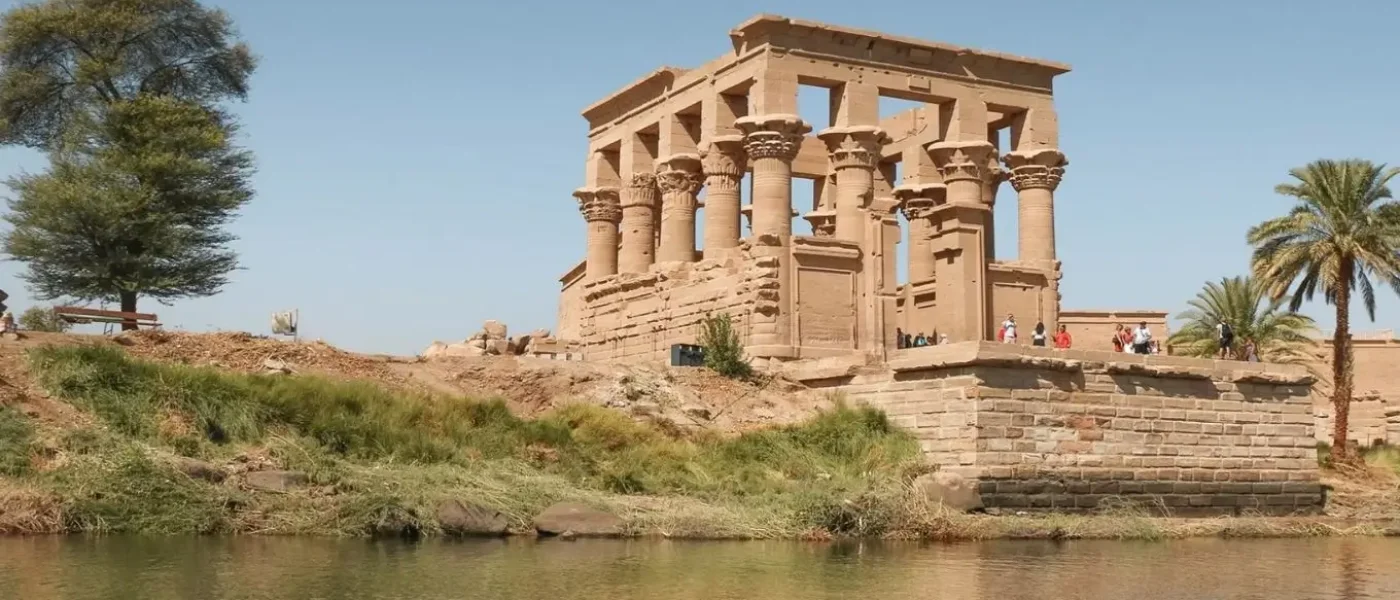
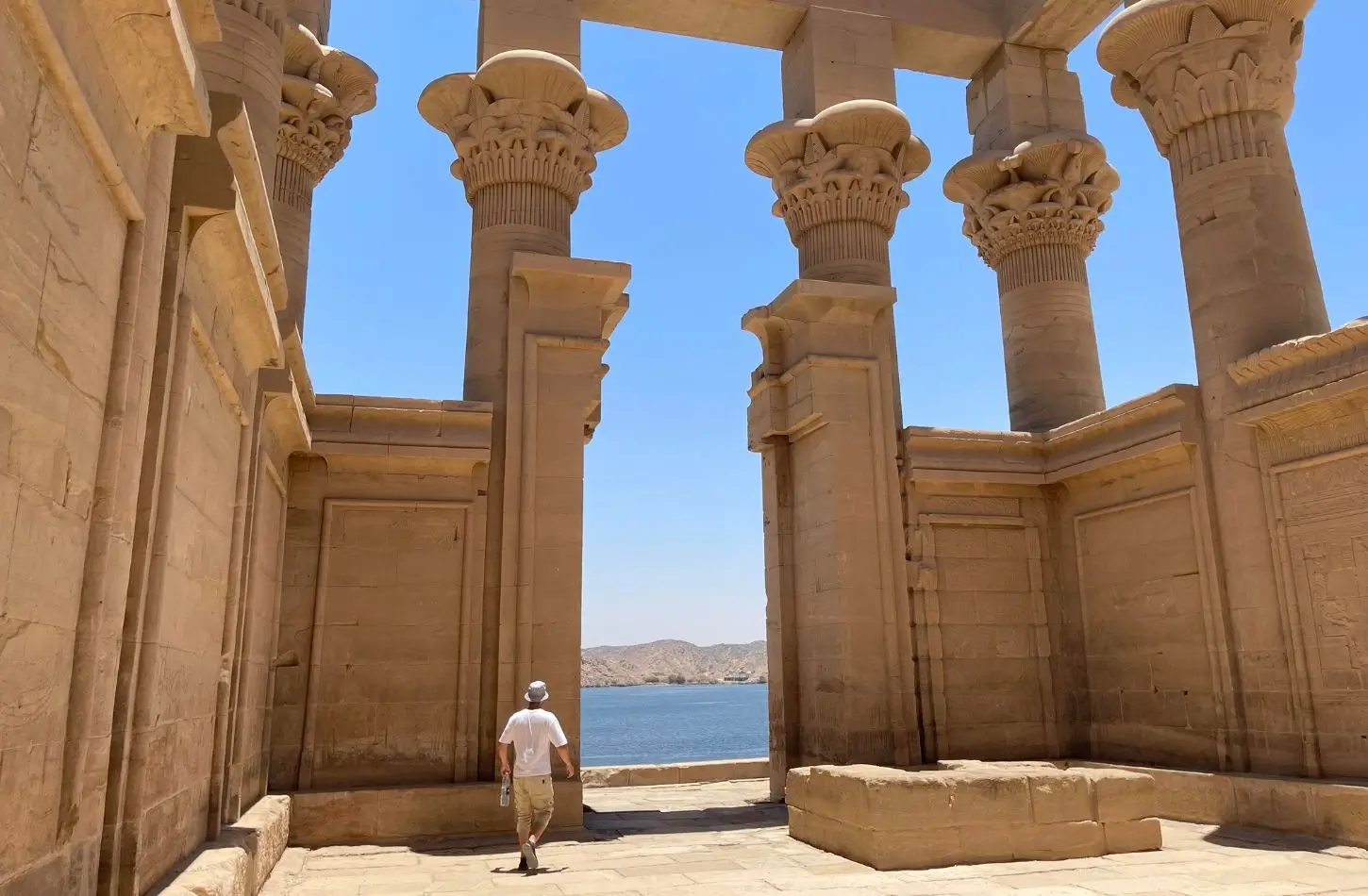
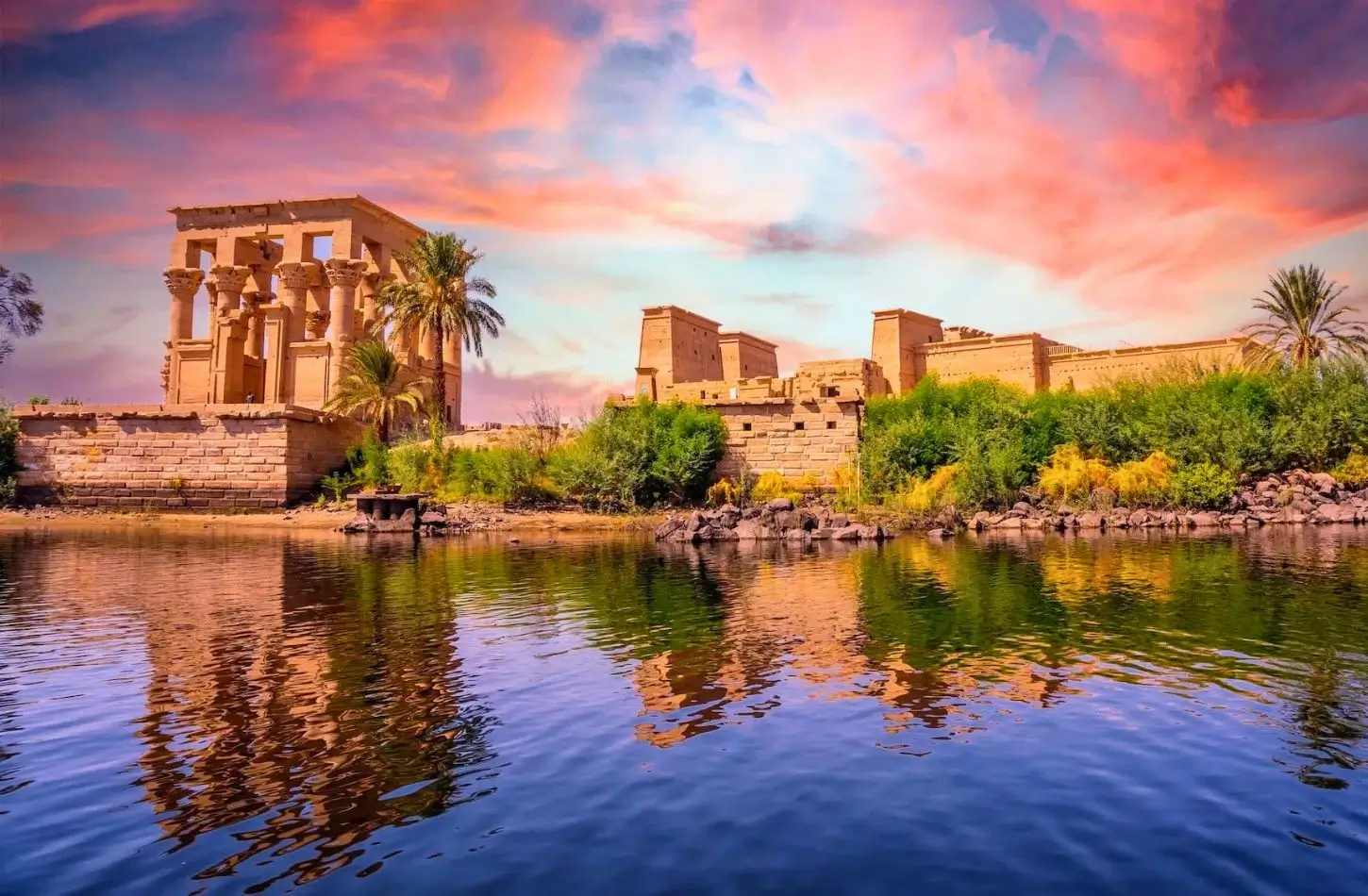
The first thing most visitors photograph, the Kiosk of Trajan, stands at the water’s edge on the island’s south side. Its fourteen columns, topped with floral capitals and the carved scenes of Emperor Trajan making offerings to Isis and Osiris, are among the most finely detailed Roman-period carvings in Egypt. Come at golden hour, and it photographs like nothing else on your entire Aswan trip.
The First and Second Pylons
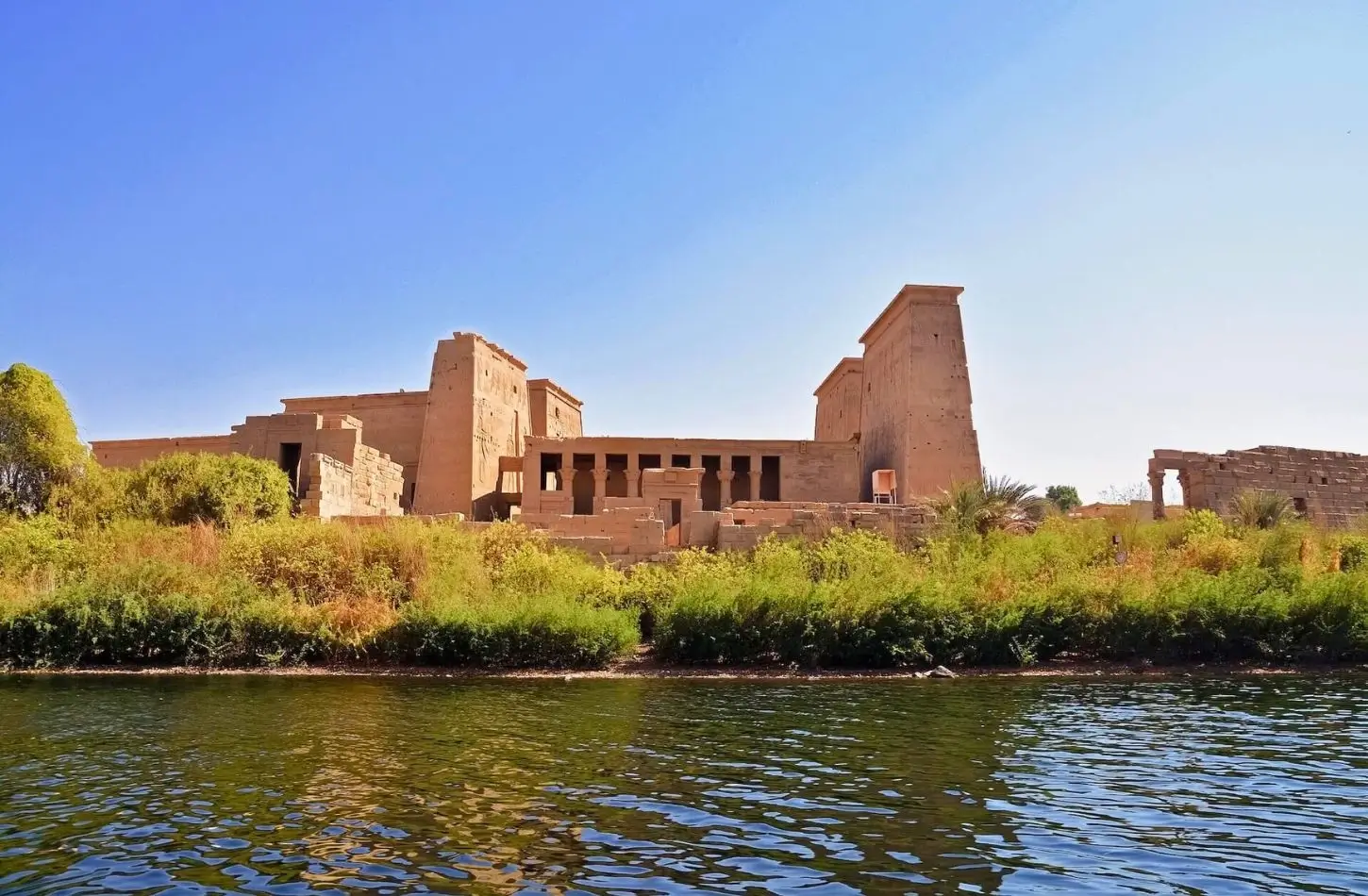
Towering gateways covered in enormous reliefs of Ptolemaic kings smiting enemies before the gods. The First Pylon is particularly well-preserved: look for the scene where Ptolemy XII grasps a cluster of prisoners by the hair — a motif repeated across thousands of years of Egyptian temple-building, here executed with Ptolemaic precision.
The Hypostyle Hall
Beyond the second pylon, ten columns with ornate floral capitals line a hall that was later converted into a Coptic church. The original wall reliefs were plastered over but are re-emerging in places. A Greek inscription above one doorway records the ‘good work’ of destroying pagan carvings — a jarring reminder of how thoroughly Egypt’s religious landscape shifted in a few centuries.
The Sanctuary of Isis
The innermost chamber of the main temple. Dimly lit by two small windows, this is where the golden statue of Isis once stood on its sacred barge during festivals. A Coptic altar still stands along one wall — in use 500 years after the last hieroglyph was carved here. Stand quietly and let the layers of history sink in.
The Nilometer
Often missed by visitors on standard Aswan city tours, the Nilometer on the island’s edge was used by ancient priests to measure flood levels and predict agricultural yields — a practical tool that shaped the entire Egyptian calendar. A useful reminder that behind the mythology was a culture of precise, empirical observation.
The Graffito of Esmet-Akhom
Ask your Aswan tour guide to point it out: the last-ever hieroglyphic inscription, dated 394 CE, is carved on the outer walls. It marks the literal end of a 3,500-year writing tradition. Small, easy to overlook, and completely extraordinary.
Philae Temple Visitor Tips: Everything You Need to Know Before You Go
Getting to Philae Temple from Aswan
Philae Temple sits on Agilkia Island, approximately 12 km south of central Aswan, between the Old Aswan Dam and the High Dam. You cannot reach it by land — the only access is a short motorboat ride from Shellal Marina (also called the Philae dock). From central Aswan, allow 20–25 minutes by taxi; negotiate the fare before you get in (around EGP 80–120 is a fair rate). Once at the marina, buy your entry ticket at the official booth near the entrance before boarding any boat.
✦ Cash only at the marina. There are no ATMs on the island itself, so exchange money at a bank in central Aswan before heading out. Careem works for the taxi to the marina, though getting a return car can be harder — ask your driver to wait or arrange a pickup.
Best Time to Visit
Early morning — arriving by 7:00 or 7:30 AM — is by far the best time to visit Philae Temple. You will beat the tour groups, have the island nearly to yourself, and the morning light across the pylons and the Nile is exceptional for photography. If mornings do not work, late afternoon from around 3:00 PM is the next best option: crowds thin out, golden-hour light is superb, and the cooler air makes walking more comfortable. The temple closes at 4:00 PM (last entry around 3:30 PM), so do not cut it too fine.
✦ October to April is the most comfortable season for Aswan Egypt tours in general. Summer months (June–August) bring intense heat, but you will almost certainly have the island to yourself.
How Much Time to Allow
Most visitors on an Aswan 1 day itinerary spend 1.5 to 2.5 hours at Philae Temple. That is enough time to walk the full complex at a relaxed pace, photograph the key structures, and absorb the atmosphere without rushing. Add a licensed guide and the time extends naturally — a knowledgeable Egyptologist turns a 90-minute walk into a genuinely revelatory experience, connecting the mythology on the walls to the historical context that makes Philae so unusual.
What to Wear and Bring
Wear comfortable, flat walking shoes — the stone paving is uneven in places. Light, breathable clothing is essential in warmer months; cover shoulders and knees as a matter of general respect at religious sites. Bring sunscreen, a hat, and your own water; the island has limited facilities. A wide-angle lens for the pylons and a zoom for relief details will serve photographers well.
✦ The Nile reflects the temple’s colonnades beautifully from the east side of the island — a shot most visitors miss entirely by heading straight for the Kiosk of Trajan.
Guided Tour vs. Self-Guided
Philae is perfectly manageable without a guide, but you will get substantially more out of it with one. The carvings reward explanation: without knowing the myth of Osiris’s dismemberment and resurrection, the scenes on the sanctuary walls are just pictures. A licensed Aswan tour guide brings the iconography alive and points out details — the Graffito of Esmet-Akhom, the Coptic altar, the place where Christians carved crosses directly over hieroglyphs — that are easy to walk past. Most Aswan tour packages include a professional Egyptologist as standard.
Put these tips to use on a perfectly planned Egypt trip
Philae Temple Sound and Light Show: Is It Worth It?
Every evening, the Sound and Light Show at Philae Temple transforms the island into something theatrical. The pylons, colonnades, and Kiosk of Trajan are illuminated in dramatic sequences of color while a narration tells the myths of Isis and Osiris across multiple languages. Visitors arrive by boat in darkness, which adds considerably to the atmosphere.
If you are visiting Aswan for more than a single day, the evening show is genuinely worth attending — particularly if you have already explored the temple during daylight. The night version reveals the scale of the architecture differently, and the mythology narration gives context that complements what you have already seen. Shows typically run two or three times per evening in different languages; check current schedules with your hotel or tour operator before traveling to the marina.
✦ Book through your hotel or a local Aswan tour operator rather than turning up independently at night. Boat logistics are simpler, and you will know the language schedule in advance.
Combining Philae with the Best Aswan Tours and Day Trips
Philae Temple pairs naturally with the other major sites around Aswan into a full and satisfying day. The most popular combination for visitors on Aswan city tours is Philae in the morning, followed by the Aswan High Dam and the Unfinished Obelisk in the afternoon. The High Dam, just a few kilometers from the Philae marina, gives important context: it is the reason Philae was moved in the first place, and seeing the scale of Lake Nasser from the dam helps you understand the engineering stakes of the UNESCO rescue mission.
For visitors who want to cover more ground, the Abu Simbel day trip from Aswan is the natural pairing with Philae — together, these two UNESCO sites are Aswan’s crown jewels. The Abu Simbel day trip from aswan requires an early departure (most convoys leave before 5:00 AM by road, or you can take a short flight), so a practical itinerary puts Abu Simbel on day one and Philae plus the High Dam on day two. This is exactly the kind of aswan and Abu Simbel combination that our 2-day Aswan tour packages are built around.
For those with just one full day in the city, it is possible to combine both on the same aswan trip — Philae in the morning after an early Abu Simbel departure — though this makes for a full schedule. A private Aswan tour guide can manage the logistics to make this work comfortably. If you are coming from the coast or Cairo specifically for this, day trip to Abu Simbel options are available that include Philae as an afternoon addition.
Arriving on a Nile cruise from Luxor? Philae is almost always the culminating excursion stop before disembarkation in Aswan. Check your aswan to Abu Simbel excursion options with your cruise operator on board, as many include both in the final days of the itinerary.
Why Philae Temple Feels Different from Other Egyptian Temples
Many first-time visitors are surprised by how the Philae Temple of Isis feels compared to the Karnak Temple or Luxor Temple. The scale is smaller, the crowds are lighter, and the island setting introduces a quality that no mainland temple can replicate: you arrive by water, as pilgrims did for over a thousand years. The moment your boat pulls away from Shellal Marina and the island appears across the Nile — pylons rising above the waterline, columns catching the morning light — is one of those genuinely transportive experiences that Egypt occasionally delivers.
The Philae Temple in Egypt also carries a different emotional weight. It was the last temple. The last place where ancient Egyptian religion survived in active practice. The last place where hieroglyphs were carved. Standing in the sanctuary of Isis, where priests performed rituals until the 6th century AD, is to stand at the very end of a 3,000-year civilization. That specificity — not ‘ancient Egypt generally’ but the precise, documented final chapter — gives Philae a gravity that its size does not immediately suggest.
Add the presence of Coptic crosses carved directly into pharaonic reliefs, Roman emperors depicted in ancient Egyptian style, and the knowledge that the entire complex was disassembled and rebuilt in living memory, and you have a site that is not just beautiful but genuinely complex — the kind of place that rewards time and thought as much as a camera.
Frequently Asked Questions About Philae Temple
Why is the Philae Temple so important?
Philae Temple is famous as one of the best-preserved Ptolemaic temples in Egypt and as the primary cult center for Isis, the goddess of magic, motherhood, and healing. It holds massive historical weight because it was one of the very last strongholds of ancient Egyptian religion; the worship of Isis continued here until the 6th century AD, long after Christianity had closed other pagan temples. It also features the last known traditional Egyptian hieroglyphic inscription ever carved, dating to 394 AD.
Why was Philae Temple moved?
The entire temple complex had to be relocated to prevent it from being completely submerged by the rising Nile waters. Following the construction of the Aswan Low Dam (1902) and the later Aswan High Dam in the 1960s, the original Philae Island was severely flooded. In the 1970s, a monumental UNESCO-led rescue project dismantled the temple stone by stone—cutting it into roughly 95,000 blocks—and perfectly reassembled it on higher ground at nearby Agilkia Island.
How do you get to Philae Temple?
Because the temple is situated on an island in the reservoir between the two Aswan dams, it is only accessible by boat. Visitors take a taxi or tour vehicle to the Marina Philae Temple (Shellal Pier), located about 12 kilometers south of central Aswan. From the pier, you must take a short, 10-minute motorboat ride across the Nile to reach Agilkia Island.
How long do you need to visit Philae Temple?
Most travelers spend about 1.5 to 2 hours exploring the island. This gives you enough time for the round-trip boat crossing, walking through the main Temple of Isis, exploring the famous Trajan’s Kiosk (the open-air Roman pavilion), and photographing the panoramic riverside views without rushing.
What is the best time of day to visit Philae Temple?
The best time to visit is early morning (around 7:00 AM to 9:00 AM) or late afternoon (after 3:30 PM). Going early or late helps you avoid the intense Upper Egypt midday heat and bypass the large cruise ship tour buses that typically arrive around mid-morning. Late afternoon also provides beautiful golden hour lighting, which is perfect for photography against the water.
Is the Philae Temple Sound and Light Show worth it?
Yes, it is widely considered one of the most atmospheric night events in Egypt. The evening show utilizes colorful, dramatic lighting, orchestral music, and narration to tell the classic mythological love story of Isis, Osiris, and Horus. Walking through the illuminated temple ruins beneath the stars offers a completely different, emotional dimension compared to the daytime visit.
Start Planning Your Aswan Tour
Philae Temple is not the largest or most famous monument in Egypt, but it may be the most complete, in the sense that it contains the full arc of a civilization in a single island complex. From Ptolemaic pylons to Roman kiosks to Coptic crosses carved over hieroglyphs, every layer of Egypt’s ancient world is present here. And unlike many of Egypt’s great sites, it still rewards arriving slowly, by water, the way pilgrims have always done.
Whether you are booking Aswan tours as a standalone trip, adding a day to a Nile cruise, or building out a full Egypt itinerary, make sure Philae Temple is on it. Pair it with the Sound and Light Show in the evening and an Abu Simbel day trip from Aswan, and you will leave Upper Egypt with an understanding of why this stretch of the Nile has drawn travelers for centuries.