
Is Edfu Temple worth visiting?
Yes — it’s Egypt’s best-preserved temple, dedicated to Horus, with an intact pylon, sanctuary & the full Horus-vs-Set myth carved on its walls. Ticket ~550 EGP ($11).
Dedicated to Horus falcon god, second-largest temple in Egypt after Karnak
Ticket ~$11 (2026) 550 EGP, cash only, open 6AM–5PM
Between Luxor & Aswan 105km from Luxor, 123km from Aswan, common cruise stop
Go at opening or late 6AM or last 2hrs beats cruise-ship crowds & heat
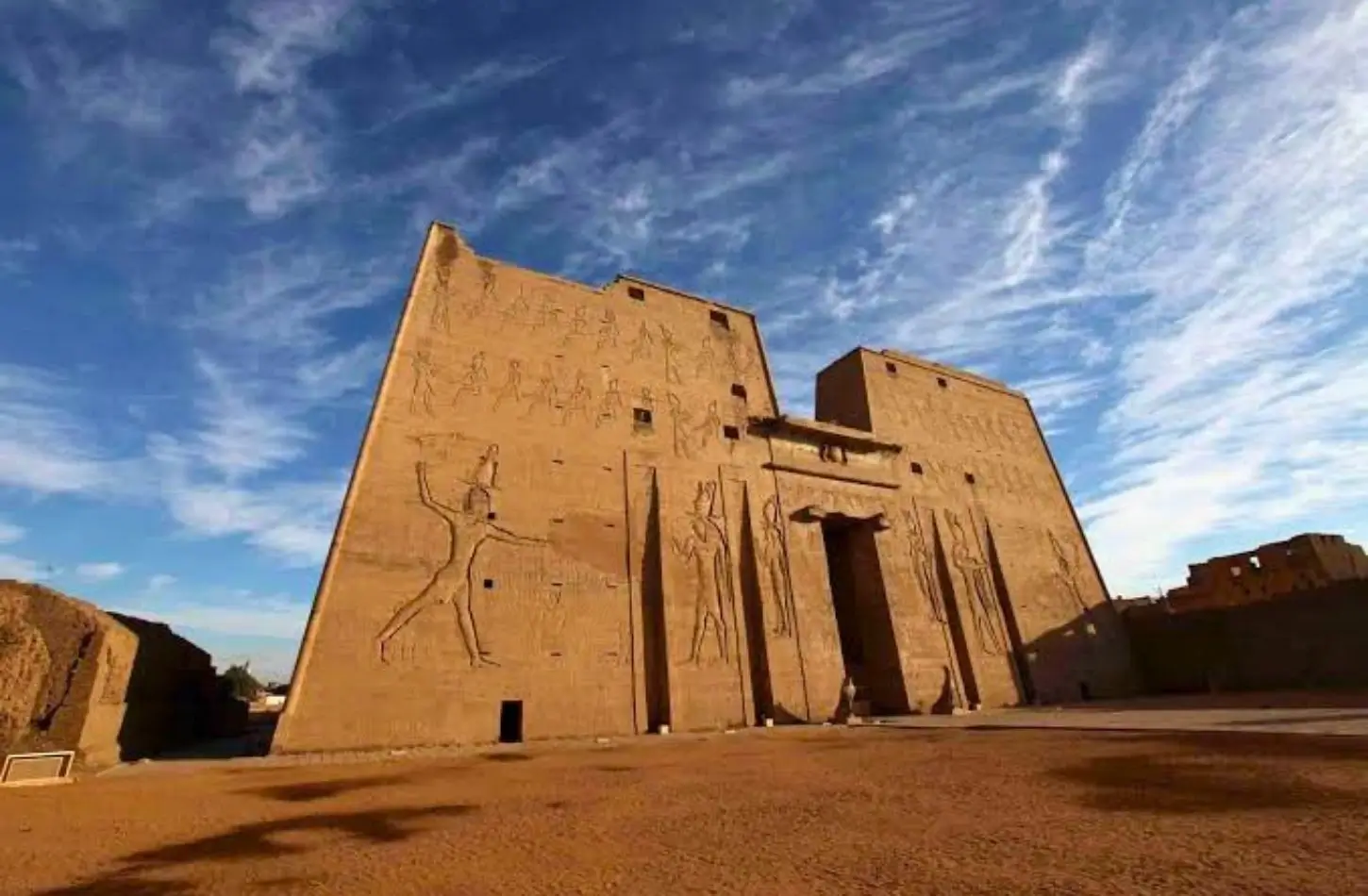
The Temple of Edfu is Egypt’s best-preserved ancient temple and the second largest after Karnak, built entirely in honor of the falcon god Horus. Almost every stone of its pylon, courtyard, and inner sanctuary survives exactly as the Ptolemaic builders left it, because desert sand buried the site for nearly 2,000 years before archaeologists uncovered it in the 19th century.
Most travelers see Edfu Temple as a stop between Luxor and Aswan — whether on a Nile cruise or a private day trip to Edfu and Kom Ombo from Luxor — but few know the ticket price, the mythology carved into its walls, or how the Edfu Temple history connects to one of ancient Egypt’s oldest legends. Here’s what actually matters before you go.
Edfu Temple History: From Ptolemaic Construction to Rediscovery
Construction of the Temple of Edfu began in 237 BC under Ptolemy III Euergetes and continued for nearly two centuries, with the temple — including its famous pylon — not fully complete until 57 BC under Ptolemy XII, father of Cleopatra VII. That timeline makes Edfu Temple history unusual: it was built by Greek-speaking rulers of Egypt, yet the design and decoration follow the same religious rules Egyptian temples had used for over a thousand years, right down to the Edfu Building Texts inscribed on the enclosure wall, which describe the temple’s own mythical origins and construction rituals.
The site itself is far older than the Ptolemaic structure standing today. Edfu had been a cult center for Horus since the New Kingdom, and earlier temples on this spot were rebuilt multiple times before the Ptolemies commissioned the version visitors walk through now.
By the 19th century, the temple had vanished beneath sand and silt, and the town of Edfu had grown directly over it — homes were built on what turned out to be the temple’s roof. Napoleon’s scholars recorded the site during the French expedition of 1798, but it wasn’t until French Egyptologist Auguste Mariette began systematic excavation in the 1860s that the temple was properly cleared. That excavation is why the complex now sits several meters below the surrounding modern town — visitors walk down into it rather than up to it, one of the clearest reminders of how completely Edfu was buried.
Edfu Temple Horus: The Falcon God and the Battle with Set
Every wall inside the Temple of Edfu tells part of the same story: the conflict between Horus and his uncle Set. In Egyptian mythology, Set murdered and dismembered Osiris, Horus’s father, and Horus spent years fighting Set to reclaim his father’s throne and avenge him. Reliefs throughout the temple, particularly around the courtyard, depict this battle in dramatic detail, including scenes of Horus spearing a hippopotamus representing Set.
Understanding the Edfu Temple Horus connection is key to appreciating the site, because the temple wasn’t built as a museum piece — it functioned as a working cult center where priests re-enacted this myth annually during the Feast of the Beautiful Meeting, when a statue of Hathor traveled by boat from Dendera to “marry” Horus at Edfu. That festival is recorded on the walls in enormous detail, making Edfu one of the richest surviving sources for how Ptolemaic-era Egyptians practiced their own mythology.
Horus appears throughout the temple as a falcon, as a falcon-headed man, and in a granite statue at the entrance — one of the most photographed images in Egyptian temple archaeology. If you remember one thing about the mythology here, it’s this: Edfu was a religious capital dedicated to the idea that order (Horus) must continually defeat chaos (Set) — a theme that also justified the pharaoh’s own right to rule.
What to See Inside the Temple of Edfu
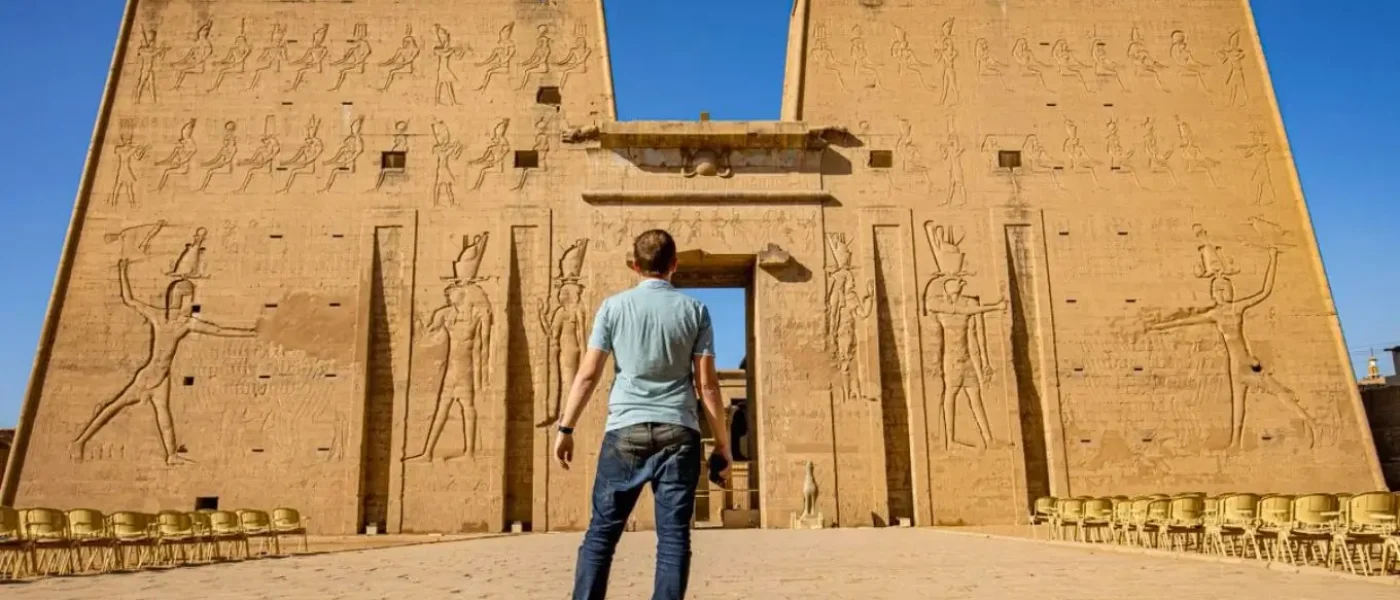
The Temple of Edfu rewards visitors who take their time, since very little of it has been lost. Start at the pylon — at 36 meters high, one of the largest in Egypt — decorated with scenes of Ptolemy XII smiting his enemies before Horus, a traditional pharaonic pose used for 3,000 years regardless of who actually ruled.
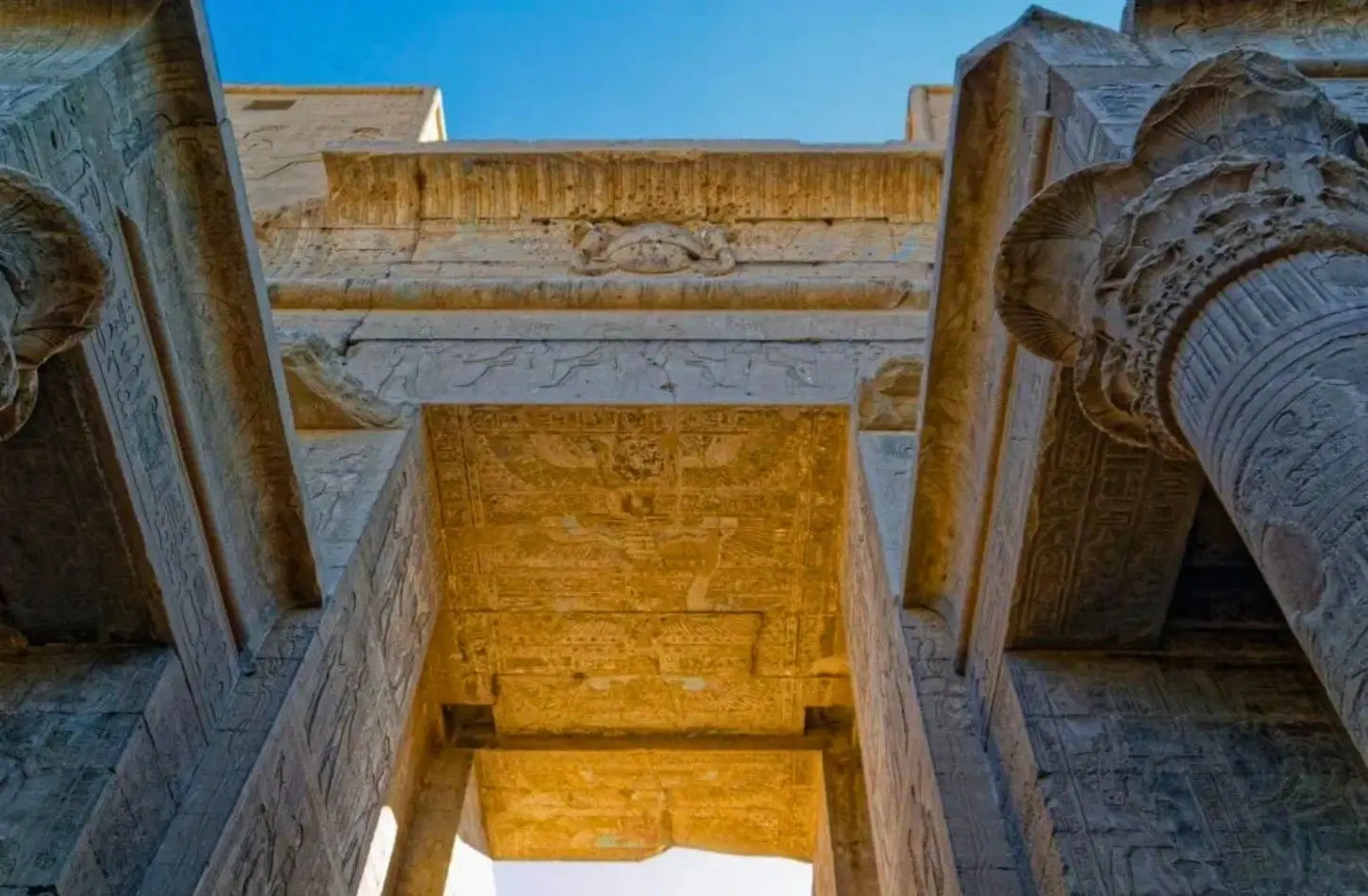
Beyond the pylon is the open peristyle court, ringed by columns, where the annual reunion festival with Hathor took place. From there, two hypostyle halls lead deeper into the temple, each darker and more restricted than the last — a deliberate design mirroring the increasing sanctity of the space as you approach the sanctuary.
The inner sanctuary still holds its original granite naos (shrine), one of the few in Egypt still in its original position, though the ceremonial barque that once sat inside it is now in the Louvre. Don’t skip the Nilometer, a stone shaft used to measure Nile flood levels and predict harvest taxes, or the mammisi (birth house) just outside the main temple, which commemorates the divine birth of Horus with its own set of reliefs. Together, these sections make Edfu one of the only places in Egypt where you can walk a complete, unmodified temple layout from pylon to sanctuary in one visit.
Edfu Temple Ticket Prices and Opening Hours (2026)
The Temple of Edfu is open daily from 6:00 am to 5:00 pm, and the earlier you arrive, the better — both to avoid the heat and to beat the crowds arriving from Nile cruise ships, which typically dock mid-morning.
As of 2026, the Edfu Temple ticket costs approximately 550 EGP (around $11 USD) for international visitors, with reduced rates for students carrying a valid international student ID. Egyptian antiquities pricing has increased several times over the past few years, so treat any specific figure — including this one — as a guide rather than a guarantee, and confirm current pricing before publishing or traveling. If you’re visiting as part of a guided day trip or Nile cruise package, your ticket is usually already included in the price.
Cash is required at the ticket window — cards aren’t accepted — so keep small Egyptian pound notes on hand. A photography permit is a separate, optional fee for professional cameras; phones are generally fine without an extra charge, though policy varies by season.
How to Get to Edfu Temple from Luxor and Aswan
Edfu sits almost exactly between Luxor and Aswan — about 105 km (65 miles) south of Luxor and 123 km (76 miles) north of Aswan — which is why nearly every Nile cruise between the two cities stops here, usually alongside Kom Ombo.
If you’re not cruising, a private day trip from Luxor is the most practical way to see it without committing to a multi-night cruise. Travelers building a longer south-of-Luxor itinerary often prefer our 4-day Luxor, Edfu, Kom Ombo, Aswan and Abu Simbel tour, which adds Abu Simbel without the cost of a full cruise. If a cruise fits your plans better, browse our Nile cruise itineraries to see which sailings include an Edfu stop.
If you arrive by cruise ship, the boat docks at a small harbor at the edge of town, and the final stretch to the temple entrance is usually covered by horse-drawn carriage or tuk-tuk. Horse-drawn carriages are the traditional option, though some travelers prefer to ask their guide about air-conditioned transport alternatives given ongoing animal welfare concerns around Edfu’s carriage horses.
Best Time to Visit & Practical Tips
The best time to visit the Temple of Edfu is either right at opening (6 am) or in the last two hours before closing, when the light is better for photos and cruise-ship crowds have either not arrived yet or already left. October through April brings cooler daytime temperatures across Upper Egypt, but even in summer, Edfu’s morning and late-afternoon slots stay manageable.
Wear light, breathable clothing that also covers shoulders and knees — you’ll be walking through open courtyards with no shade for stretches at a time. A hat, sunscreen, and a water bottle are non-negotiable between May and September.
A licensed Egyptologist guide is optional but genuinely useful at Edfu, since so much of what makes the temple significant is the mythology carved into its walls rather than the architecture alone. Our Things to Do in Luxor guide covers where Edfu fits if you’re planning a wider Luxor-area itinerary.
FAQS about Temple of Edfu
What is the Temple of Edfu famous for?
The Temple of Edfu is famous for being the best-preserved temple in Egypt, with its pylon, courtyard, and sanctuary surviving almost fully intact. It’s dedicated to the falcon god Horus and covered in detailed reliefs depicting his mythical battle with Set, making it one of the richest sources of Ptolemaic-era Egyptian mythology anywhere in the country.
How much is the Edfu Temple ticket price in 2026?
The Edfu Temple ticket costs approximately 550 EGP (around $11 USD) for international visitors as of 2026, with discounted rates for students. Egyptian antiquities pricing changes periodically, so it’s worth confirming the current fee before your visit, or booking a guided tour where the ticket is already included.
Is Edfu Temple dedicated to Horus?
Yes, Edfu Temple is dedicated entirely to Horus, the falcon-headed god of kingship and protection. The temple’s reliefs, sanctuary, and annual festivals all centered on Horus’s mythology, particularly his battle against Set to avenge his father Osiris.
How old is the Temple of Edfu?
The Temple of Edfu was built between 237 and 57 BC during the Ptolemaic period, making it roughly 2,260 years old. The site itself had been a Horus cult center since much earlier, though the structure visitors see today dates specifically to the Ptolemaic rebuilding.
How far is Edfu Temple from Luxor and Aswan?
Edfu Temple sits about 105 km south of Luxor and 123 km north of Aswan, roughly midway between the two cities. Most visitors reach it either as a stop on a Nile cruise or on a private day trip from Luxor that also includes Kom Ombo.
Do I need a guide to visit Edfu Temple?
A guide isn’t required to enter Edfu Temple, but it’s strongly recommended given how much of the site’s meaning comes from its carved mythology rather than its architecture. A licensed Egyptologist can explain the Horus-and-Set reliefs and the temple’s role in ancient festivals that aren’t obvious without context.
Conclusion
The Temple of Edfu earns its reputation as Egypt’s best-preserved temple honestly — between the intact pylon, the sanctuary’s original shrine, and walls that still narrate the full Horus-and-Set myth, there’s more to see here than at almost any other single site between Luxor and Aswan. Whether you’re adding it to a Nile cruise stop or booking a dedicated day trip, going in with the history and mythology in mind turns a quick photo stop into one of the most memorable temple visits in Egypt. Ready to see it for yourself? Explore our day trip to Edfu and Kom Ombo from Luxor and let a licensed Egyptologist guide walk you through it.